CerModern
Ahmet Yiğider’s Art: “A Complex Neuron Organization”
This text is based on Emre Zeytinoğlu’s essay “Ahmet Yiğider’s Art: A Complex Neuronal Organization”, originally published in the book “Sensuality in Sculpture & The Ant Nest”, which accompanied the exhibition “Ant Nest” held at CerModern between February 27 and March 23, 2025. It is presented here in a revised and shortened version:
The cornerstones of Ahmet Yiğider’s art are almost entirely shaped by intersensory transitions, shifts, and interpretations. Everything we experience creates a different activity pattern in the brain — which means that his work essentially consists of design experiments on neuronal organization. In other words, as David Eagleman and Jonah Lehrer put it, they are “electrochemical interpretations played in a dark theatre.” Beyond scientific data, these works at times find echoes in literary texts as well.
design and science; that is, the artist has an education covering these fields and continues his laboratory studies on the senses of smell and taste in the scientific field, independent of art… Ahmet Yiğider, who received his undergraduate education in the Department of Industrial Engineering at Yıldız Technical University and completed his master’s degree in the Department of Design at the Faculty of Architecture at Istanbul Technical University, explains his own formation in the following lines in the exhibition catalogue titled “Intellect”:
For me, engineering means being friends with matter and materials. In this respect, it promises a strong infrastructure for art technique. Industrial and Systems Engineering, on the other hand, offers system foresight for production systems and social and economic models. Design is a conditional, calculated, and ultra-disciplinary art practice while understanding it in an interdisciplinary depth.[i]
[i] Ahmet Yiğider, “Intellect” sergi kataloğu, Fine Art Gallery-Moskova, 2020.
This educational and professional background we are talking about stands out very clearly in the artist’s installation titled “Fig, Human, Soil” at the 9th Çanakkale Biennial, where he participated. The character of the work is created by the scent effect combined with visuality… He makes the following statement about his installation:
This installation divides the space with cotton thread dangles and scent molecules. The path formed between two lines, the boundaries of which are determined by the scent, narrows as it progresses and takes the viewer to a single point. The scent of the earth. On both sides of the installation, on one side, the scent of figs turns into the scent of the world with every step, and on the other side, the “scent of humans” turns into the scent of the earth with every step. The scent of figs and the scent of humans lose their character as they progress and turn into a familiar scent of the world at the meeting point.[ii]
[ii] Ahmet Yiğider, “9. Çanakkale Bienali “İncir, İnsan, Toprak” broşürü, 2024.
Figs, humans and soil, inserted into different channels in the gallery space, create scents. They merge with each other and turn into a “single nature”, and the result of that transformation is conveyed to the viewer again through combined scents. This evolves into the smell of nature, including humans, with the scent of soil that dominates the installation. The artist’s goal here is this: In the distant future, when humans have disappeared, first reaching the reality of “human” and then reaching the soil, which is an unchanging factor in nature… Or this: What will remain of humans in nature after they have disappeared?
The artist speaks of a new will to consciousness: The desire to reach the cognitive remains of the human species that came into being with the evolution of the “primate order” millions of years ago and to perceive the unchanging relationship that species established with nature… Or the effort to measure the cognitive partnership with humans from millions of years ago… This does not resemble a working process similar to archaeological or biological research; because, like every branch of science, these two branches of science are full of “positive data” defined according to different ideologies in the process that has come to “today” and all of them have been legitimized by “today’s consciousness”. However, this installation wants to implement the opposite of those “positive data”: To establish the connection between humans and nature and, therefore, to determine the cognitive partnership within the framework of that connection… To witness the purest and most original, and simultaneously the never-changing character of humans, at the starting point… The artist chooses the perception of smell as the most suitable material. As the method that can meet the desire to sense, see and know, the farthest from manipulation: Smell… As the most unchanging and uninterruptable data by external factors: Human smell…
Can it really be that “a creature that first evolved into a human” has a smell that has never changed? It is also possible to ask: Can we talk about a scent that has determined humanity’s life in nature and ensured its survival from that “humanoid”, that is, a “hominid”, until now? Moreover, if there is a smell that undertakes the function of “sustaining existence”, is this a feature that only belongs to humans?
Ahmet Yiğider suggests that mammals other than humans also have characteristic smells and suggests this with the example of a “deer species”. According to the artist, that species owes its vital continuity to a smell: Musk… Again, in the brochure prepared for the “Fig, Human, Soil” installation at the 9th Çanakkale Biennial, the following explanation is included:
Musk is the name of the strong-smelling compound secreted by a male deer species in its body and accumulated at a point close to its testicles. Its primary purpose is to ensure that this species attracts its own mate. As we can attribute to the general body odour character of the creature in question, since it is at a point close to the urinary bladder, it is clearly noticeable in the urine smell of the beast during the reproductive period.[iii]
[iii] A.g.e.
However, the artist really wants the human smell in this installation. This is the scent that he tries to combine with the smell of figs and soil, and thus return humans to a place that truly belongs to nature or to their “home” millions of years ago. Let’s go back to our previous question: Could there really be a scent that has never changed since “a creature first evolved into a human”? The first answer that comes to mind here is this: The characteristics humans have accumulated since the “beginning of the species”, passing through all the evolutionary processes and reaching “today”, perhaps emerge in their purest form immediately after birth. A species-specific scent is data that carries those accumulated characteristics, including variable conditions. We don’t know this exactly, but we have no other field of research than the “state of purity” of a baby. David Eagleman also suggests the “looking at a baby” method to find this “state of purity”:
Our brains constantly make social judgments. But do we acquire this skill through experiences, or is it innate? One way to understand this is to investigate the existence of this characteristic in babies. /…We often assume that reliability is a phenomenon we learn through years of experience. However, such simple experiments show that even in infancy, we are equipped with antennas to help us find our way.[iv]
[iv] Eagleman, s. 164-165.
Ahmet Yiğider must have the same idea to obtain the characteristic human smell and transfer it to his installation because he embarks on a series of experiments on baby skin to reach that smell. In other words, instead of the question asked by David Eagleman, “What is the nature of human behaviour?” Ahmet Yiğider asks, “What is the nature of human smell?” to find a reliable answer, he resorts to “baby skin smell.” The artist’s experiment in question is explained as follows:
Yiğider’s findings of volatile molecules obtained by GC-MS analysis [a sensitive study of volatile substances using a combination of gas chromatography and mass spectrometry] on neutral fabrics that were left on the skin of a sleeping baby (mainly in the neck area) for 8 hours with the permission and control of their parents, show that they have the character of “human smell.” It has formed the basis for. At this point, isovaleric acid, hexanal (aldehyde C-6), heptanal (aldehyde C-7), octanal (aldehyde C-8), nonanal (aldehyde C-9) molecules can be exemplified as the most basic and dominant volatile compounds in the installation. The effect of food, which is one of the most important external factors on the odour characteristic of an adult’s skin, preserves its pure and original character in the baby experiment at the breast milk stage. Breast milk offers a tremendous filtering feature regarding the odours passing from food to the skin. For the artist, the findings obtained by analyzing the volatile components taken from the baby’s skin and the accumulation of general literature constitute a fundamental and scientific basis.[v]
[v] 9. Çanakkale Bienali broşürü.
Independent of all kinds of scientific research described above, baby odour directly relates to every person’s experience. It can be easily said that People already have knowledge and judgment about the “natural human odour”, and they have no doubt that the baby odour is the “purest human odour”. As mentioned above, this situation is also closely related to literature. Patrick Süskind’s novel “The Story of a Murderer” is the most striking example. In the novel, a wet nurse refuses to breastfeed a baby given to her and says that the devil has entered it. However, the baby is neither able to speak yet nor does it emit a disturbing odour. Some of the conversations between the wet nurse and the priest Terrier, who wants to hand the baby over to her, are narrated in the novel as follows:
“But why, poor woman?” said Terrier, rummaging through the basket with handles again. “Look, this is the cutest baby in the world. It is pink, does not cry, sleeps beautifully, and is baptized.”
“The devil has entered it.”
Terrier quickly pulled his hand out of the basket.
“No way! The devil can’t enter a wet baby. The wet baby is not a human being yet; it is a preliminary human being and does not yet have a fully developed soul. Therefore, it does not attract the devil’s attention. Has the baby started talking? Is it struggling all the time? Is it moving things in the room? Is it emitting a foul odour?[vi]
The “devil child” that Priest Terrier tried to describe was connected to specific events related to his own belief system, such as the “bad” words the baby might say, struggle, a foul smell or having supernatural powers… However, the wet nurse’s “devil child” judgment emerges as a result of a pretty different observation and tells Priest Terrier:
“It doesn’t smell at all.”[vii]
The wet nurse declaring a child who doesn’t smell at all “devil” must also be an indication of another superstition; however, the following dialogue between the wet nurse and Priest Terrier that follows immediately afterwards should also be considered:
[vi] Patrick Süskind, Koku / Bir Katilin Hikâyesi, Çev: Tevfik Turan, Can Yay. 2024 (70. Baskı), s. 16.
[vii] A.g.e. s. 16.
“Healthy for that reason,” Terrier shouted, “healthy for that reason; it doesn’t smell! Only sick children smell; that’s a known fact. As is known, a child with smallpox smells like horse manure, a child with scarlet fever smells like rotten apples, and a child with tuberculosis smells like onions. This one is healthy; that’s all it lacks! Do you want it to smell bad? Do your own children smell?
“No,” said the woman. “My children smell like a human baby should smell. /…This doesn’t smell like a child.”[viii]
Smelling like a child… This is a “spontaneous” thought of people; a child should have a scent specific to its own species… That is a scent that a baby has not yet been exposed to any external influences but has acquired only as a reflection of breast milk on its skin… Ahmet Yiğider says, “Breast milk offers an incredible filtering feature in terms of scents passing from food to skin.” So that is why the artist while searching for the most reliable data for “pure human scent,” decides on the scent of a baby and places it in his installation to define a human in nature.
The scene between the wet nurse and priest Terrier presents us with another conversation that could lead us in a different direction; the crucial point here is again a judgment of the wet nurse… During the discussion in question, priest Terrier asks the nurse the following, with some anger and some anxiety:
“We will take back the word ‘devil’ then. That’s good. But I beg you, can you tell me what a wet baby smells like if it smells like you believe it should? Hmm?
The wet nurse responds:
“It smells good.”[ix]
[viii] A.g.e. s. 17.
[ix] A.g.e. s. 18.
The wet nurse’s final decision is this: The smell of a baby is pleasant; that’s all there is to it… But how can that smell be defined? And what does the word “beautiful” mean to that smell? Trying to define “beautiful” on its own would suggest going through the entire “history of philosophy” and scanning for ideas that agree or conflict with each other, which is neither necessary nor possible in this text. Moreover, what we call “beautiful” has no “absolutely real” equivalent in philosophy that has been exemplified within the scope of perceptions: “The beautiful object is exactly this”… Furthermore, since it is not possible to define taste, sound, sense of touch and smell without associating them with any “thing”, it is clear that these cannot gain the definition of “absolutely real” on their own, either in philosophy or in art. Therefore, we will not know the exact equivalent of the wet nurse’s sentence, “The baby smells good”, and the wet nurse does not know that smell either. So, while reading this novel, we ask ourselves the following questions that are stuck in a deadlock: What was the smell the wet nurse smelled in her children but not in the other baby? What “thing” did the “beautiful” smell of her children come from? If the “beautiful” smell is a baby’s smell, then how should that baby smell? There will be no end to such questions; the questions will loop with each other, and it will be impossible for us to reach a definitive answer. Still, we have the chance to ask, “What makes a person beautiful in the perception of others?” Once again, we look at David Eagleman, but this time, to another of his books, “Incognito / The Secret Life of the Brain”… There is a definition there as follows:
What people describe as “beautiful” reflects fertility signals resulting from hormonal changes.[x]
[x] David Eagleman, Incognito / Beynin Gizli Hayatı, Çev: Zeynep Arık Tozar, Domingo Yay. 2021 (42. Baskı), s. 92.
These lines talk about the formation of the female and male organs depending on these hormones. It is understood that the following is emphasised: “I am full of estrogen, and I am fertile.” However, this formation is valid for visual perception. David Eagleman continues his explanations by also addressing the factor of smell and suggests that what makes a person attractive is, again, the data belonging to the natural structure:
The judgments made about beauty are shaped not only by the visual system’s effect but also by smell. Smell carries a lot of information about the age, gender, fertility, identity, emotions and health of the potential partner. The carrier of the information is a fleet of molecules flowing from one place to another.[xi]
We can understand from the explanations that the smell that the wet nurse expected from that baby was a component of the smells that could reveal all the naturalness that the baby had innately brought. Thus, that was the smell she called “beautiful.” And in that case, that smell was also the smell of the naturalness that a person could carry, that is, the absolute relationship with nature. Therefore, the meaning of the baby smell obtained and used in Ahmet Yiğider’s laboratory studies in his installation “Fig, Human, Soil” was revealed here.
[xi] A.g.e. s. 97.
Now we are thinking: Where do we place the musk smell that Ahmet Yiğider obtained concerning a deer species? There is also detail; the artist added these musk molecules to the scent he received from the baby’s skin and aimed to reach a “fertility smell” that belongs to all mammals. In this way, he ensured that fig, human, and soil factors were mentioned simultaneously with “all of nature” or “the character of nature”. However, such a scent composition is not limited to this installation alone; in the next stage, the pure human smell or the symbolic smells belonging to all mammals also pass to all other living beings in nature. The artist’s area of interest is an area that expands from animals to trees.
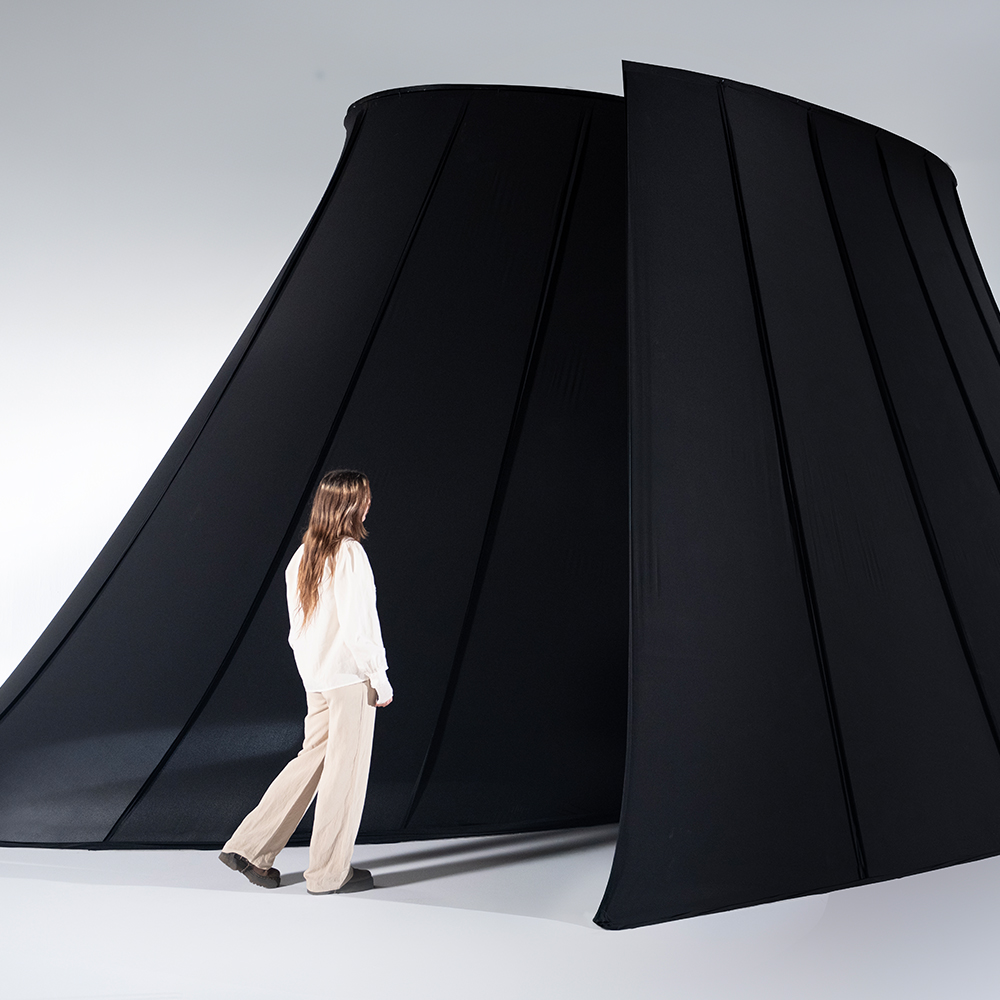
The “Ant Nest” installation consists of a conical form in the middle of the space resembling an ant nest. This nest, which has a spiral plan made of metal, is covered with a slightly transparent fabric. The viewer, who follows the scent inside the cone, reaches the centre of the nest thanks to the increasingly intense scent. Considering the artist’s other works, this installation seems like the final step that takes us from the unity of “nature and humans” to the unity of “nature and all living things”. For the artist, each living thing should have characteristic scents, and each work should be loaded with these scents. In that sense, after the previous installation, “Fig, Human, Soil”, which included the smell of humans, it is no surprise that the main factor of “Ant Nest” is the ants’ scent.
For every stimulus, ants are exposed to triggers to emit different odorous secretions. The scents of these secretions emerge in such diverse situations that Ahmet Yiğider’s chemical analyses of the ants’ body tissues reach over 1000 molecules. This can be considered a giant encyclopedia about nature. The artist says the following about this work:
The viewer can reach the point where the “ant smell” is most intense by walking from the spiral area at the base section of the conical form towards the centre. Although the spreading smell is noticeable throughout the hall, the intensity increases as the viewer progresses in the spiral within the conical structure towards the centre. Using the power of art, senses and especially the sense of smell, I wanted to draw attention to a silent narrative, a whisper between the ant species, which is one of the minor bodies we can see with the naked eye but has the most significant animal biomass in nature, and humans. The ant species, which I hope to get one step closer to with this provocative experience, follows the traces of entirely social life, and the smells of its species continue to be secreted at every moment.[xii]
[xii] Cermodern “Karınca Yuvası” notları, 2024.
Let’s repeat the following thought we stated above for the sensory work titled “Ant Nest”; we said: “When we consider the artist’s other works, this installation takes us from the unity of ‘nature and human’ to ‘nature and “It seems like the final step of a process that leads to the unity of all living things.” It is so, but still, this transition from the human scent to the ant scent does not mean listing the scents of different living things one after the other and separately in each exhibition. Throughout the artist’s exhibitions, these scents establish a connection between human and animal species and also refer to the unity between all living things and nature by including plants in the work.
It is possible to make some determinations about the unity in question… First, let’s look at the relationship between the installations focusing on “human and ant”; these present us with two seemingly different yet intertwined situations. The first situation is the form of sociality that can be established between these two species… Perhaps the simplest thing that comes to mind is that humans and ants create their own sociality, and each assumes a task within that sociality… For example, ants establish a successful agricultural strategy, and, like humans, they form a civilization based on agriculture. This sociality follows an oblique and rather indirect path; in other words, in an ant colony, no “single individual” works for his own benefit. As long as that ant can be a member of collective movements, it can benefit itself. David Eagleman explains the issue of “benefit” in the colony as follows:
Leaf-cutter ants grow their food in the colonies they form, consisting of millions of members. Some ants leave the nest to search for fresh plants, and when they find them, they carry large pieces of the plant they bite off and bring them back to the nest. However, the ants do not eat these leaves. The smaller worker ants take the leaf pieces, chew them, break them into smaller pieces, and use them as fertilizer for the mushrooms they grow in their extensive underground “gardens.” The mushrooms they feed this way form tiny spore-producing buds that the ants will later eat. /…What each ant does alone is quite simple. The ant simply obeys local instructions and rules.[xiii]
[xiii] Eagleman, Beyin / Senin Hikâyen, s. 231.
How reminiscent of human sociality, especially the industrial society of the 18th century… Here, we can understand how human and ant species, and indeed all living species, benefit from nature, sustain its existence and integrate with it to a certain extent. Still, of course, we must set aside man’s increasing ambition to “destroy nature for the sake of benefit” and think about it from another perspective.
However, in this human-ant relationship, there is another overlap that is much more interesting and detailed than the social similarity; that is the overlap between ant sociality and “human consciousness”… This time, we read the following passage from David Eagleman:
To understand human consciousness, we need to think not about the parts and components of the brain but how these components interact. If we want to see how simple parts can create something bigger than themselves, there is no need to look further than the nearest ant nest. /… The trick here is the interaction between ants. And the same applies to the brain. A neuron is just a specialized cell, like the other cells in your body. The main difference between them is that they develop extensions with specific features that allow them to transmit electrical signals.[xiv]
[xiv] A.g.e. s. 232.
So, the neurons of ants and human brains spend their lives applying general rules. While ants reveal complex colony behaviours with seemingly simple movements, neurons reveal humans similarly. By defining the neuron organization of the brain… Therefore, reading the “Ant Nest” installation from different perspectives is possible. When that installation is combined with the “Fig, Human, Soil” installation, it can spread to a much wider area of thought.
As a result, if we want to talk about Ahmet Yiğider’s art as a whole, we need to briefly touch on his sculptures. Although these sculptures seem to be different works than installations, they refer to the ” perception ” problem encompassing the artist’s works. Of course, the perception of smell should be at the forefront of his works. For example, in these wooden sculptures, the perception of smell is a factor that distinguishes wood types from each other and defines their place in nature, regardless of their forms. In other words, while a viewer sees the forms of these sculptures and attempts to make symbolic meanings and artistic classifications in his mind, the smells he perceives from them force that viewer to make a different classification: The wooden features and forms of the sculptures themselves and the classification of their smells in nature… Just like the viewer who sees the installations “Fig, Human, Soil” and “Ant Nest” is obliged to separate them according to the qualities of their smells, in addition to their pure visuality… But beyond this, Ahmet Yiğider’s sculptures are not just made up of wooden material; he also brings different perceptions into play.
It also uses metal, stone and composite materials. Although these materials will undoubtedly yield some results other than the perception of smell, they still have the same effect regarding “image formation”. We know that every type of perception enters into coordination in the brain and establishes surprising relationships among themselves. In other words, sensory data flows are in constant motion in neurons… However, they have different speeds; this timing difference causes the senses to trigger each other and “touch receives effects from sight”, “smell from taste”, etc. Eric R. Kandel states the following in his book “Reductionism in Art and Brain Science”:
Modern Brain Science revealed that specific brain regions thought to specialize in processing visual information are also activated by the sense of touch. A critical area that responds to an object’s sight and touch is located in the lateral occipital cortex. The texture of an object, whether perceived by the eye or the hand, activates a neighbouring region of the brain, the medial occipital cortex. /…Our brain processes only visual information when we first look at a painting or other object. It is thought that additional information will be processed by other senses soon. This creates a multisensory representation of the object in higher brain regions. Combining visual information with information from other senses enables us to classify different materials. [xv]
[xv] Eric R. Kandel, Sanatta ve Beyin Biliminde İndirgemecilik / İki Kültür Arasında Köprü Kurmak, Çev: Mehmet Doğan, KÜY Yay. Koç Üniversitesi Yay. 2020, s. 41.
Let’s repeat the last sentence of the quote: “Combining visual information with information from other senses enables us to classify different materials.” We can use this sentence for Ahmet Yiğider’s sculptures, or we can use it as the main idea of this article about him. Suppose his sculptures are completed by the influence of other senses and visuality. In that case, his installations are completed using the same sensory coordination. Again, in a sentence above, while mentioning his “Anthill” installation, we said: “In fact, when we consider the artist’s other works, this installation seems like the final step of a process that takes us from the unity of ‘nature and humans’ to the unity of ‘nature and all living things’.” And now we can slightly modify this sentence by also considering his sculptures: All of the artist’s works are the counterparts of a process that takes us from the unity of “nature and humans” to the unity of “nature and all living things” and tries to transform nature into a complete unity of perception. As he stated during an interview:
Since my childhood, the centre of my awareness has been this: There is an infinity surrounding humans. Call it nature or the universe. Existence begins with wondering about this infinity and the shell between you and this infinity. It continues with the effort to understand and make sense of it. And here, science is the most essential tool. While I am full of art, it played a significant role in my interest in nature and science and later in my turning to engineering. Regardless of the field or fields he entered, I think “if a person loses his curiosity and the urge to explore, he will not be able to exist in art or any other creative field.”[xvi]
[xvi] Gülistan Ertik – Ahmet Yiğider, “Kültür Sanat Haritası, Konuklar, Söyleşiler” 2021.
[i] Ahmet Yiğider, “Intellect” sergi kataloğu, Fine Art Gallery-Moskova, 2020.
[ii] Ahmet Yiğider, “9. Çanakkale Bienali “İncir, İnsan, Toprak” broşürü, 2024.
[iii] A.g.e.
[iv] Eagleman, s. 164-165.
[v] 9. Çanakkale Bienali broşürü.
[vi] Patrick Süskind, Koku / Bir Katilin Hikâyesi, Çev: Tevfik Turan, Can Yay. 2024 (70. Baskı), s. 16.
[vii] A.g.e. s. 16.
[viii] A.g.e. s. 17.
[ix] A.g.e. s. 18.
[x] David Eagleman, Incognito / Beynin Gizli Hayatı, Çev: Zeynep Arık Tozar, Domingo Yay. 2021 (42. Baskı), s. 92.
[xi] A.g.e. s. 97.
[xii] Cermodern “Karınca Yuvası” notları, 2024.
[xiii] Eagleman, Beyin / Senin Hikâyen, s. 231.
[xiv] A.g.e. s. 232.
[xv] Eric R. Kandel, Sanatta ve Beyin Biliminde İndirgemecilik / İki Kültür Arasında Köprü Kurmak, Çev: Mehmet Doğan, KÜY Yay. Koç Üniversitesi Yay. 2020, s. 41.
[xvi] Gülistan Ertik – Ahmet Yiğider, “Kültür Sanat Haritası, Konuklar, Söyleşiler” 2021.
www.cermodern.org
CerModern