T24
Sümeyra Gümrah, In Search of the Essence of Architecture: On “TÖZ” with Ali Artun and Ahmet Yiğider — A Contemplative Field Close to Philosophical Discourse…

TÖZ
January 12, 2026
At its origin, architecture did not merely respond to the need for shelter; it also corresponded to humanity’s relationship with the universe. Stone, beyond being a building material, was a bearer of meaning through its rhythm, proportion, and silent language. Arches, voids, and coverings were part of an intuitive architectural understanding that connected human beings to a scale beyond themselves.
Over time, this language receded. With industrialization and modernization, architecture increasingly settled into the domain of the measurable, of function, and of rational order. The poetic and symbolic, meanwhile, were long pushed outside the boundaries of architecture.
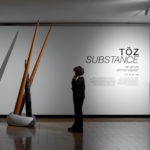
Today, the effort to reconnect with this ancient essence appears at the intersection of two distinct intellectual trajectories. Ali Artun, who has long examined the autonomy of art and the theoretical structure of modernism, and Ahmet Yiğider, who transforms material into a sensory experience through his sculptural practice, come together on this shared ground through the exhibition TÖZ. The exhibition will be on view at the Galata Greek School between January 17 and February 8, 2026. Prior to this, we sought to understand what “TÖZ” signifies for both Artun and Yiğider.
“Göbeklitepe, where architecture writes a mythology…”
– When we hear “TÖZ,” we think of a philosophical term. Is it an idea or an intuition? Could you give examples of structures that embody this concept?
Ali Artun: “Töz” corresponds to “substance” or “essence.” It is the core, the root of something. In architecture, it refers to the theology, spirituality, knowledge, geometry, mystery, and poetry of a work—not its function, rationality, or intellect, but its imagination.
Examples of a poetic architectural tradition beyond rationalism are limitless. In my recently published book Ziggurat, I compiled around 800 works from this lineage. Let me mention a few favorites: Kurt Schwitters’ never-ending Merzbau house made of debris, Kazimir Malevich’s Arkitektoniki projects that envelop the sky, Giovanni Battista Piranesi’s prisons—and above all, Göbeklitepe, where architecture writes a mythology.
– When was this essence pushed aside or forgotten?
A. Artun: After the Renaissance, the regime of knowledge changed. Most importantly for architecture, geometry and arithmetic became scientific. Forms and numbers lost all their symbolism and mystery. In other words, architecture lost the language through which it expressed its essence. It began transforming into a design science that disciplines human space and life, much like today.
“Göbeklitepe, where architecture writes a mythology…”
– When we hear “TÖZ,” we think of a philosophical term. Is it an idea or an intuition? Could you give examples of structures that embody this concept?
Ali Artun: “Töz” corresponds to “substance” or “essence.” It is the core, the root of something. In architecture, it refers to the theology, spirituality, knowledge, geometry, mystery, and poetry of a work—not its function, rationality, or intellect, but its imagination.
Examples of a poetic architectural tradition beyond rationalism are limitless. In my recently published book Ziggurat, I compiled around 800 works from this lineage. Let me mention a few favorites: Kurt Schwitters’ never-ending Merzbau house made of debris, Kazimir Malevich’s Arkitektoniki projects that envelop the sky, Giovanni Battista Piranesi’s prisons—and above all, Göbeklitepe, where architecture writes a mythology.
– When was this essence pushed aside or forgotten?
A. Artun: After the Renaissance, the regime of knowledge changed. Most importantly for architecture, geometry and arithmetic became scientific. Forms and numbers lost all their symbolism and mystery. In other words, architecture lost the language through which it expressed its essence. It began transforming into a design science that disciplines human space and life, much like today.

– Architects such as Gehry, Hadid, Tschumi, and Libeskind are often described as pushing the limits of rational architecture. When and why did architecture move beyond rational language toward a poetic search?
A. Artun: As you know, this group initiated a movement against modernist architecture in the 1970s and came to be defined as “postmodernists.” They were influenced, above all, by Derrida and the renowned “1968 philosophers” of France. They rejected rationalism and functionalism, conceiving architecture as a “text.” They pursued a poetic architecture. Eventually, works such as Gehry’s Bilbao Museum emerged. The aesthetic of Zaha Hadid, who acknowledged her inspiration from Malevich, was particularly influential.
– As an art historian trained in architecture, you have long studied the historical sources of architecture and the lineage of “dreamlike architecture.” Where does TÖZ stand within this intellectual work? Was it planned, or did it emerge organically?
A. Artun: While working for years on the historical sources of architecture and surveying the accumulation of “dreamlike architecture,” certain assemblages began to emerge spontaneously. When friends insisted that I exhibit them, a few exhibitions naturally followed.
– In this exhibition, two languages stand side by side: theory and architectural memory on one hand, senses and material on the other. What brought you together?
A. Artun: The essence of architecture.
Ahmet Yiğider: In my artistic production—especially in sculpture—I speak of a kind of utopia. I imagine a field in which the contribution of the visible—thus material and technique—is refined, purified, almost reduced to the threshold of absence; yet where intellectual and expressive power still persists. In a sense, a “zero point”—but expression remains, and remains strong.
As “TÖZ” took shape as the main idea of the exhibition, I felt that this search fully overlapped with my sculpture. This purification, this search for essence, is as old as human history. One of the most striking examples for me is Göbeklitepe and its surrounding remains. Whether we describe these as an abstraction effort spanning more than ten thousand years, or as a form of exaltation or sacralization, these remarkably simple forms stand before us with their power and mystery.
– The Galata Greek School is a building that speaks. What was your first impression? Did the space impose limits?
A. Yiğider: It is a place I have known even before its restoration through art events, and one I have always felt warmly toward. With the restoration, it has clearly advanced in terms of exhibition possibilities. Its original function as a school can create certain scale-related challenges, especially for sculpture and installation. However, the spirit of the space is very strong; it has a distinctive aesthetic. It became a space we enjoyed both conceptually and during installation.
A. Artun: Exciting, inspiring, and spacious.

“Closer to philosophical literature; a field of contemplation…”
– What did the word “TÖZ” evoke for you? An idea or a feeling?
A. Yiğider: The word does not point to a singular or direct meaning. It is closer to philosophical discourse; it opens a space for contemplation and retains a sense of mystery. This ambiguity is important to me.
Encountering new concepts that resonate with one’s artistic production is always exciting. Since I internalized “TÖZ” to such a degree, it was not difficult to rethink my sculptures from different periods around it. What brings my works together with those of Ali Artun in this exhibition is precisely this shared sensibility.
– Scent plays a defining role in your work. Is this personal or conceptual?
A. Yiğider: Scent is a sensory field we often overlook, yet it has a powerful connection to memory. My relationship with it has always been strong, perhaps also due to my connection to nature.
An artwork is the perceptible side of artistic thought. In the plastic arts, this is central. Therefore, a work should be conceived as a complete whole. Sensory media like scent must not be added afterward; they must reside at the very core of the idea and its realization. Otherwise, they risk becoming decorative. In my interdisciplinary works, scent occupies this delicate position.
In Ant Colony, I reproduced scent molecules used by ants for communication through laboratory experiments. In Fig, Human, Soil, created for the 9th Çanakkale Biennial, I analyzed scent molecules collected from a baby’s skin during sleep. The transformation between human, fig, and soil scents opened a reflection on the unity between human and nature.

– What kind of bodily experience awaits the viewer in TÖZ?
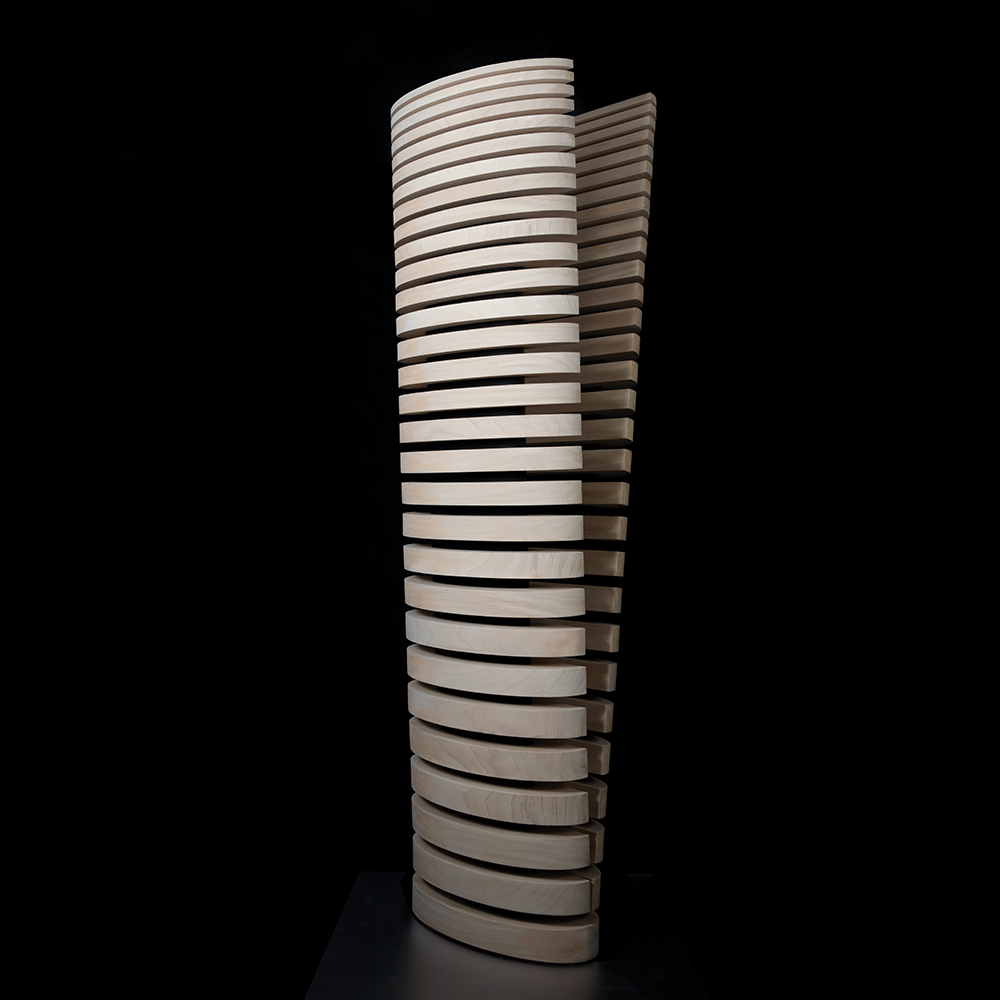
A. Yiğider: The exhibition is shaped around a strong central idea—both deep and expansive. My sculptural series, such as Power Series and Detractive Anatomies, naturally merged with this idea through their simplicity. Ali Artun’s curatorial contribution has been decisive.
We are also curious about the viewer’s response. But my hope is that the viewer suspends time, wanders through an ancient memory, and touches, even slightly, humanity’s dreamlike and intuitive reflex.
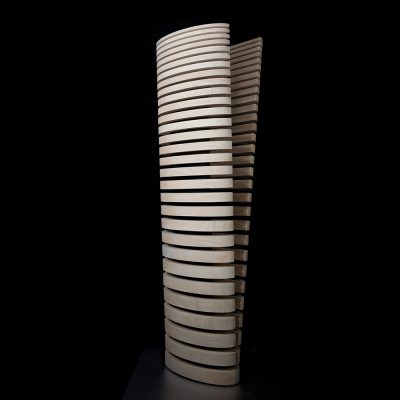
“TÖZ pursues the dreamlike architecture of humanity”
– “Human, Nature, Universe.” Which side does the balance lean toward?
A. Yiğider: We try to understand existence through these three. Nature is the most concrete. The universe is a vast enigma. The human, though physically small, carries an inner unknown—perhaps as mysterious as the universe. TÖZ pursues the dreamlike architecture of humanity. This search touches nature, the human, and the unknown.
– What should the viewer take away?
A. Yiğider: Contemplation. If the viewer experiences that, we will have both given much—and received even more.