Nez Magazine
Ahmet Yiğider
By Clara Muller

Trained in industrial engineering and later in design, Turkish artist Ahmet Yiğider has developed a versatile and deeply multisensory practice. Through the use of materials such as aromatic woods or soap, his sculptural work engages sight and touch as much as smell. With Scent of Baksı in 2016, he embarked on a more assertive conceptual exploration of this latter sense and thus initiated a lasting collaboration with the Turkish fragrance house Seluz Fragrances & Flavors Company.
Since then, the artist has deepened his reflection on olfactory perception as a way of “reading” the world – a line of inquiry he pursues through both experimentation and education. In 2021, he invited aspiring designers from Istanbul Bilgi University to translate scents into forms and concepts; in 2024, he led a workshop at the Baksı Museum introducing young artists to a rediscovery of local landscapes through the prism of smell. Ahmet Yiğider views scent molecules as a means of understanding and sharing knowledge about the beings inhabiting the Earth, but also of reflecting on their connections. This approach runs through works such as Fig, Human, Soil (2024), in which the scent of a fig tree and the scent of human skin gradually shift toward an earthy aroma, like a convergence of the plant and animal realms toward a common origin: bacterial life, largely responsible for the scent of soil. He is also contributing to the “Endemics of Türkiye” project, led by Seluz Fragrances & Flavors, which aims to document the scents of Anatolia’s endemic flora using headspace analysis and gas chromatography coupled with mass spectrometry (GC-MS).
These analyses, intended to inform future reconstructions, could allow a wider audience to discover these plants, most of which are rare.

Ant Nest
Presented in early 2025 at CerModern in Ankara, curated by Dilek Karaaziz Şener, the installation Ant Nest (Karınca Yuvası) extends Ahmet Yiğider’s interest in the invisible beings that weave the living world[cite: 1]. Fascinated by ants – eusocial insects whose collective organization relies largely on chemical communication – the artist studied the behaviors of individuals of the species Lasius niger within neutral environments, before analyzing their volatile emissions via GC-MS. His observations align with those of specialists in these insects – known as myrmecologists – who have to date identified over 1,000 different hydrocarbons on the cuticles of ants from various species, as well as some 30 semio-chemical compounds, which play a key role in orientation, feeding, aggregation, reproduction and defense. Since some of these molecules are perfectly detectable by the human sense of smell, the artist has used them to compose a fragrance described as “formic,” intended to guide visitors toward the heart of his installation.
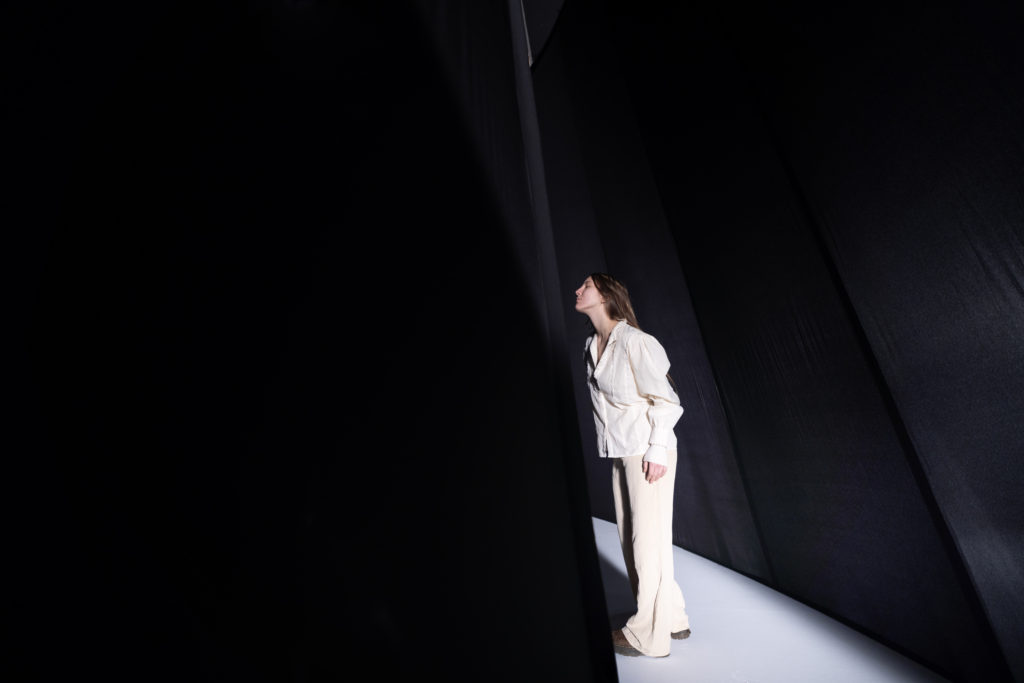
Composed of a metal frame covered with a dark, semi-opaque fabric, the work takes on a spiral shape reminiscent of an anthill. Upon entering, visitors follow – much like the ants themselves – an olfactory trail whose intensity gradually increases, accompanied by a muffled, repetitive sound vibration emanating from the heart of the “nest.” Ant Nest thus becomes a whole-body experience that, fleetingly, shifts its focus and orients itself according to non-visual and non-human cues. Ahmet Yiğider transforms the vibrations and scent molecules that foster intraspecific cohesion among Formicidae into a medium for interspecific relationship and consideration. By inviting us to pay attention to the forms of communication that organize the world beneath our feet, the work opens a space for a sensory encounter with these discreet societies, which nonetheless constitute one of the planet’s most significant animal biomasses.
Visitors follow – much like the ants themselves – an olfactory trail whose intensity gradually increases.

